
The Hidden Patterns Behind SAT Reading & Writing Questions
Success on the SAT Reading & Writing section is not simply a matter of reading faster or analyzing text. Many high-scoring students develop the ability to recognize recurring patterns in question design, answer choices, and common traps when preparing for the exam.

The SAT is a “standardized” examination administered to students across the world; the test must maintain a high degree of objectivity and consistency. Every question must have one clearly correct answer that can be justified using evidence and established scoring criteria.
In the Mathematics section, achieving this level of objectivity is relatively straightforward. Mathematical problems are designed around fixed rules and procedures, allowing answers to be verified through calculation. As a result, there is little room for disagreement regarding the correct response.
The SAT, however, operates under a different set of requirements. As a standardized examination administered to millions of students, every Reading & Writing question must have one clearly defensible answer. College Board cannot rely on subjective interpretation when scoring an exam at such a large scale. Questions must therefore be designed in a way that allows one answer choice to be objectively supported by the text, while the remaining choices contain identifiable flaws.
This requirement for objectivity creates patterns throughout the exam. Although passages change from test to test, the logic behind correct answers and common distractors remains remarkably consistent. Students who recognize these recurring patterns are often able to navigate Reading & Writing questions more efficiently than those who rely solely on reading ability or intuition.
The Hidden Traps of SAT Preparation
Many students prepare for the SAT by practicing many questions from variety of sources such as The Princeton Review, Mometrix, Kaplan, etc. However, there is a reason why this type of preparation may not be an effective way to study for the SAT. While resources such as Princeton Review, Kaplan, and Mometrix can provide useful practice, they are ultimately written by companies attempting to imitate College Board's testing style.
Students who spend most of their time studying non-College Board questions may become familiar with the patterns of those publishers rather than the patterns that appear on the actual SAT. For this reason, understanding how College Board designs its questions is often more valuable than simply increasing the number of practice questions completed.
Reading Question Patterns
In the SAT/PSAT Reading & Writing module, the same question patterns appear repeatedly across different exams. While the passages themselves may change, the underlying question types often remain the same.
Some common examples include:
Textual Evidence Questions
Function Questions
Weaken the Claim Questions
One reason pattern recognition is so effective is that many question types are accompanied by recurring trigger phrases that signal what the test is asking students to do.
For example:
Textual Evidence Questions
Often signaled by phrases such as "Based on the text" or "According to the text."
Function Questions
Often ask students to determine the purpose or role of a particular sentence, detail, or line within the passage; “function of the underlined text”.
Weaken the Claim Questions
Often ask which finding, piece of evidence, or statement would most “weaken the statement”.
By learning to recognize these trigger phrases, students can often identify the underlying question type before they even begin evaluating the answer choices. This allows them to approach questions with a clearer strategy and a stronger understanding of what the test is actually assessing.
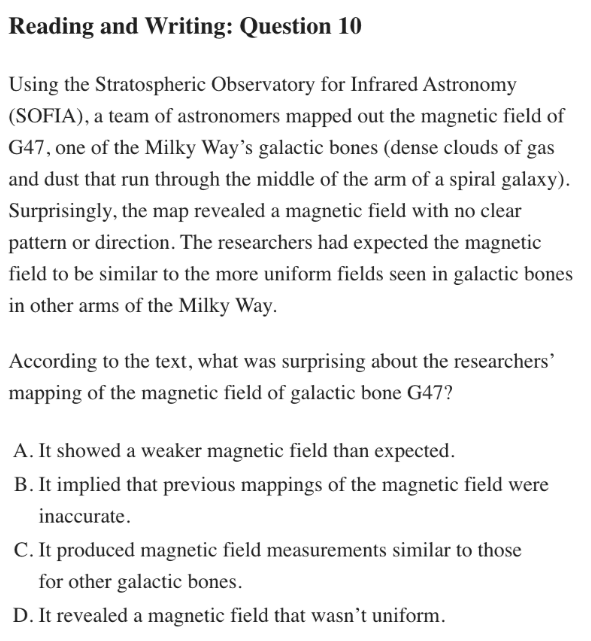
“According to the text” Question from College Board PSAT 8/9 Practice Exam

Another “According to the text” from College Board PSAT 8/9 Practice Exam
Reading Multiple Choice Questions
Interestingly, patterns are not limited to the questions themselves. Similar patterns can often be found in the answer choices.
Many SAT and PSAT Reading & Writing answers begin with recurring phrases that signal a particular function. In Function Questions, for example, students may frequently encounter answer choices beginning with phrases such as:
"To introduce..."
"To explain..."
"To emphasize..."
"To highlight..."
Over time, students begin to recognize how these recurring answer structures correspond to specific textual functions.
As a result, strong test-takers are often able to eliminate incorrect choices more efficiently and identify the most accurate answer with greater confidence. Rather than viewing every answer choice as entirely new, they learn to recognize familiar patterns that appear repeatedly throughout the exam.
The Power of Pattern Recognition
Because the exam is standardized, College Board cannot create an unlimited number of question structures. Every question must assess a specific skill, contain one objectively correct answer, and remain fair for all test takers. As a result, similar patterns naturally emerge across different exams.
For example, a Function Question may ask about a sentence in a science passage on one test and a historical passage on another. Although the topics are different, the underlying skill being assessed remains the same.
This is why high-scoring students often focus less on the topic of the passage and more on the underlying pattern of the question. Rather than viewing each question as entirely new, they learn to recognize familiar structures that appear repeatedly throughout the exam
A More Strategic Approach to SAT/PSAT Preparation
Understanding patterns is only the first step. The more important question is how students train themselves to recognize these patterns consistently.
Many students believe that completing a large number of practice questions will automatically lead to higher scores. While practice is certainly important, improvement often depends more on the quality of review than the quantity of questions completed.
The MetaPrep Method: A Systematic Approach to Score Improvement
At MetaPrep, we believe that meaningful score improvement comes from understanding the patterns behind the exam rather than simply memorizing rules or completing endless practice questions.
Our SAT and PSAT programs focus on pattern recognition, strategic analysis, individualized study plans, and structured skill development. Each student receives targeted instruction based on their strengths, weaknesses, and long-term goals.
About the Author
Kim is the founder and lead instructor of MetaPrep. A University of Virginia graduate with over 10 years of instruction experience, she specializes in Digital SAT and PSAT preparation, focusing on strategic problem-solving, pattern recognition, and individualized student support.
Why Desmos Training Is Now a Core Part of SAT Preparation

Desmos is no longer just an optional calculator—it has become an essential part of Digital SAT preparation. In this post, we'll explore how Desmos works on the Digital SAT and share practical tips for using it efficiently on test day.
What Is Desmos?
Desmos is an advanced online graphing calculator that is built directly into the Digital PSAT and SAT testing platform. Unlike a traditional handheld calculator, Desmos allows students to graph equations, create tables, analyze functions, and visualize mathematical relationships in real time.
Because it is integrated into the Bluebook testing application, students can access Desmos throughout the entire Math section without needing any additional software or equipment.
Importance in the Collegeboard Exams
Since the PSAT and SAT transitioned to digital testing in 2023 and 2024, Desmos has become an essential tool for students preparing for College Board exams. Many students spend hours studying content, but receive little instruction on how to use the calculator built directly into the testing platform.
Here is a glimpse of what this math tool looks like in the Bluebook.
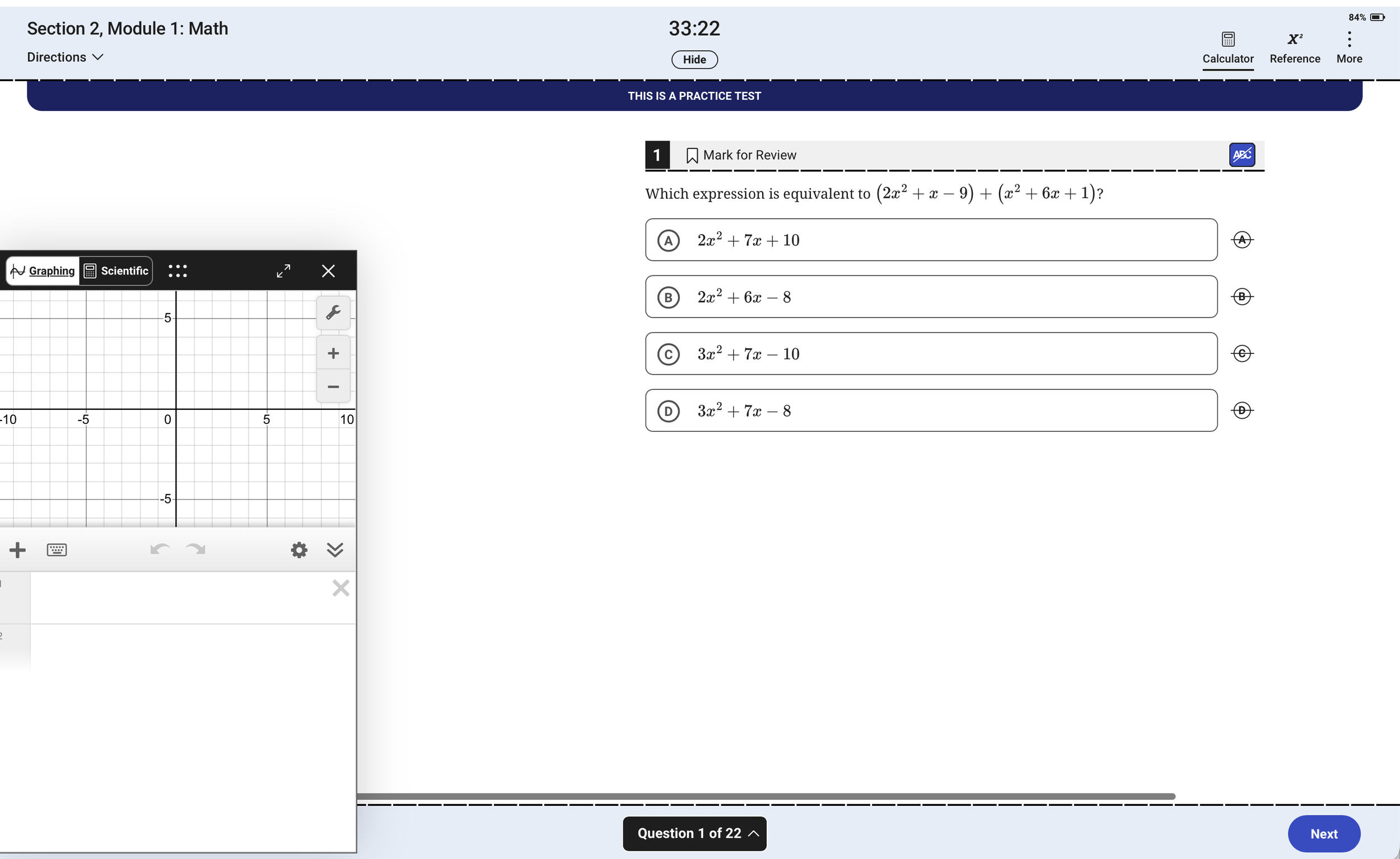
Pop-up box on the left shows Graphing Desmos tool. Bluebook allows student to switch to Scientific & Graphing versions.
Common Uses of Desmos on the SAT
Graphing Functions and Equations
One of the most common uses of Desmos is graphing equations. Instead of solving every problem algebraically, students can often graph a function and analyze its behavior visually. This can be particularly helpful when working with linear equations, quadratics, and exponential functions.
Checking Answers
Even when students solve a problem using traditional methods, Desmos can be used to verify the answer. A quick graph or table can help confirm whether a solution makes sense before moving on to the next question.
Using Tables to Identify Patterns
The table feature allows students to quickly observe relationships between variables. This can be useful for questions involving functions, rates of change, and numerical patterns where visualizing values may be easier than performing lengthy calculations.
Finding X-Intercepts and Y-Intercepts
Many SAT questions involve identifying where a graph crosses the x-axis or y-axis. Desmos can display these points directly, helping students solve certain problems more efficiently.
Understanding Transformations
Students can use Desmos to visualize how graphs change when equations are shifted, stretched, reflected, or compressed. This can make abstract concepts easier to understand and apply on test day.
Comparing Multiple Functions
Desmos makes it easy to graph several functions simultaneously. Students can compare graphs, identify similarities and differences, and analyze how changing parameters affects the shape of a function.
Desmos Features Many Students Don't Know About
Perhaps the biggest misconception is that Desmos is only a calculator. In reality, many high-scoring students use it as a visualization tool, a formula replacement, and in some cases, a time saving tool.
Using Desmos to Find Distance Between Two Points
Traditionally, students learn the Distance Formula:
d = √[(x₂ − x₁)² + (y₂ − y₁)²]
While students should still understand the underlying concept, students can save time by entering two points directly into Desmos.
Type “distance” and in the wide parentheses, type in the two coordinates. Make sure the coordinates are in their own parenthesis and separate with a comma!
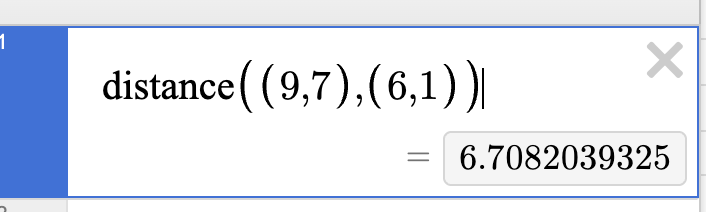
You can simply type “distance” and put your two points with a comma.
Using the Slider Tool
Some SAT questions ask students to understand how changing a number in an equation affects the graph.
The graph y = 5x^2 + 3x - k passes through the point (0.53, 0). What is the value of k?
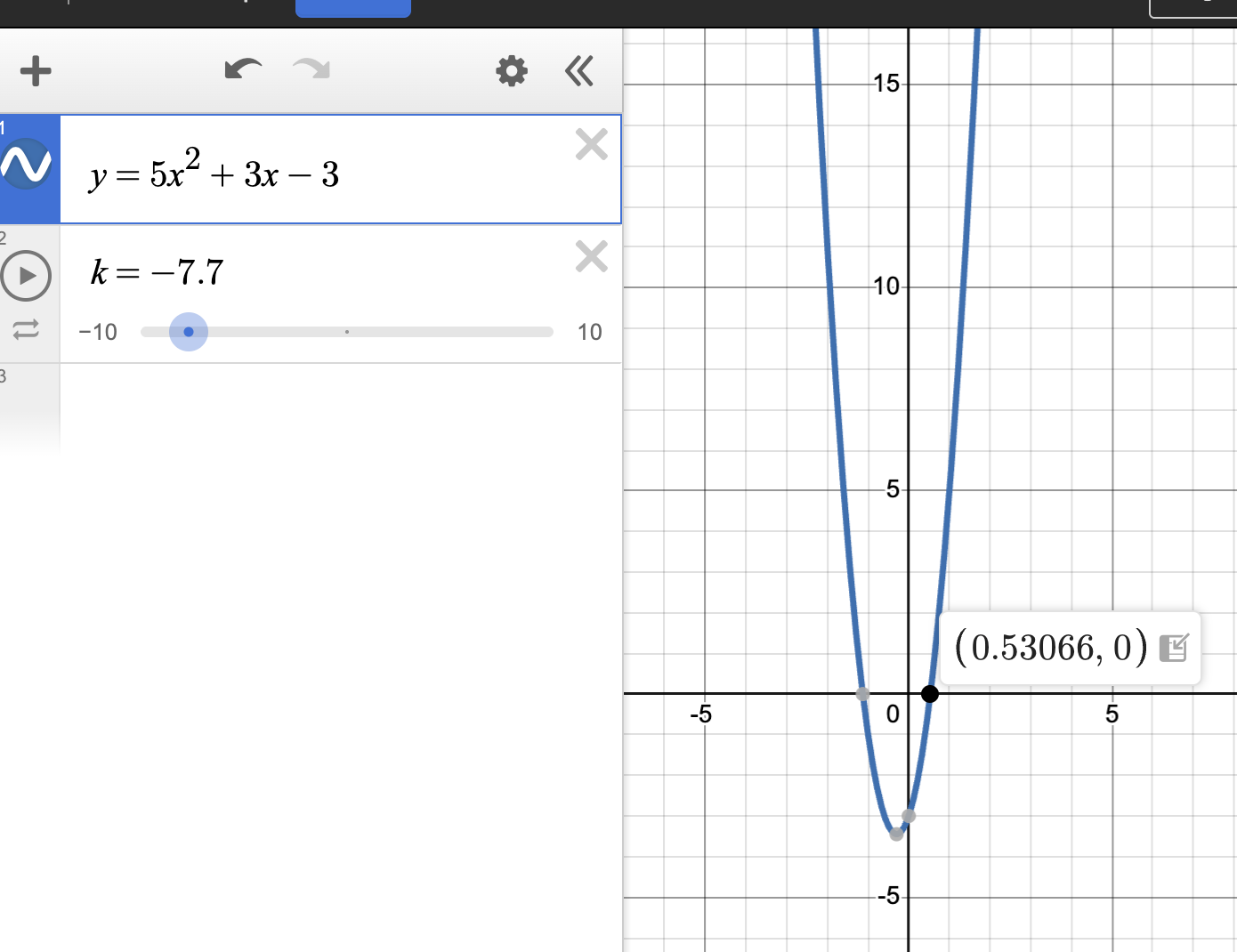
Desmos will create a slider for k. Students can then move the slider until the graph passes through the point (0.53066,0).
Let Desmos Do the Statistics!
Students can find the mean and median without spending time working out the math.
You can type mean() and median(), and insert numbers in any order in the parentheses for Desmos.
Using the Table Feature to Test Values
While many students use Desmos only for graphing, the table feature can be equally useful. It allows students to quickly generate values as well as forming different equations.
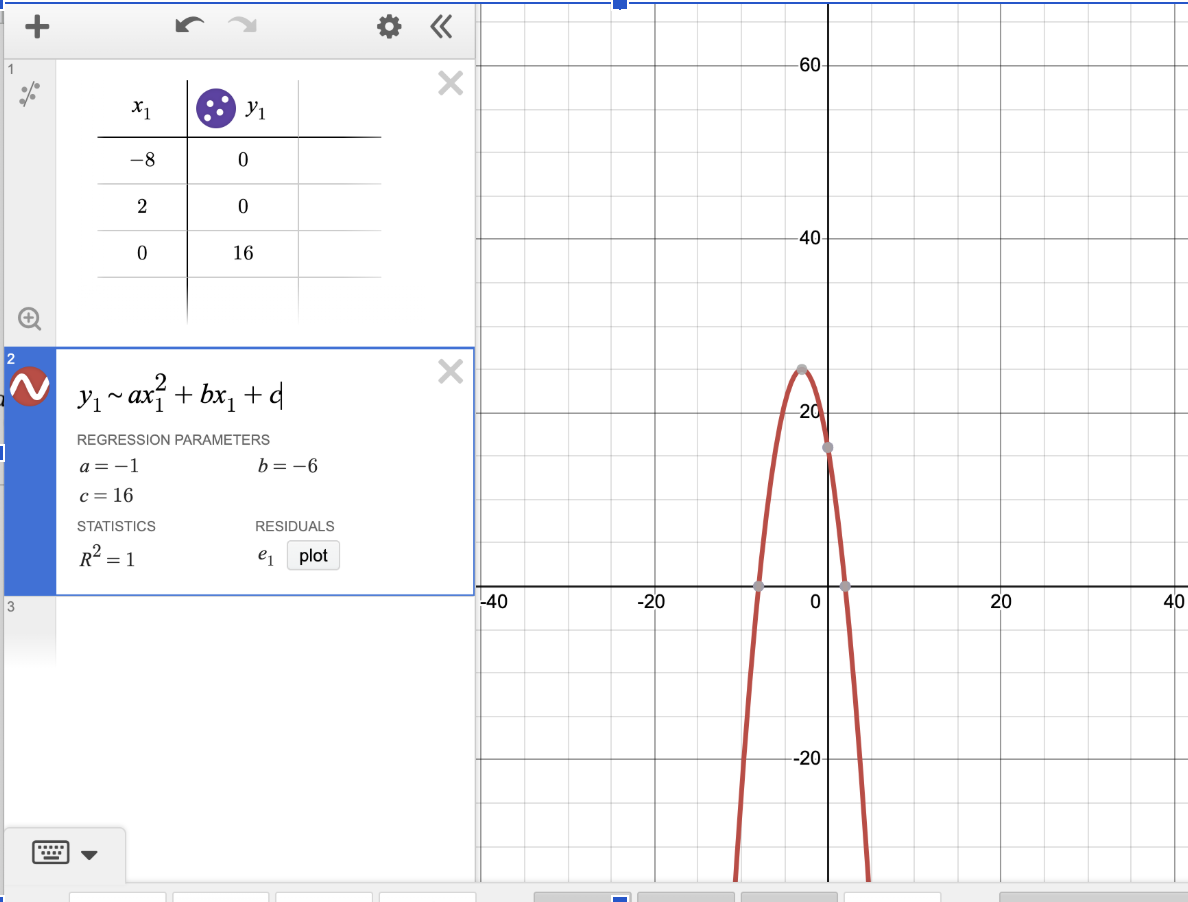
With three or more coordinates, table becomes an extremely useful for forming equations and finding values for parts of an equation.
Final Thoughts
When used strategically, Desmos can help answer exam questions with shortcuts and reduce errors. By combining strong content knowledge with effective Desmos skills, students can approach the Digital PSAT and SAT with greater efficiency and confidence.
Like any test-taking tool, Desmos is most effective when practiced before exam day. The earlier students become familiar with its features, the better prepared they will be to take advantage of them when it matters most.
Interested in SAT or PSAT Preparation?
Learn more about individualized SAT and PSAT programs or schedule a consultation to discuss your student's goals.
About the Author
Kim is the founder and lead instructor of MetaPrep. A University of Virginia graduate with over 10 years of instruction experience, she specializes in Digital SAT and PSAT preparation, focusing on strategic problem-solving, pattern recognition, and individualized student support.