The Hidden Patterns Behind SAT Reading & Writing Questions
Success on the SAT Reading & Writing section is not simply a matter of reading faster or analyzing text. Many high-scoring students develop the ability to recognize recurring patterns in question design, answer choices, and common traps when preparing for the exam.

The SAT is a “standardized” examination administered to students across the world; the test must maintain a high degree of objectivity and consistency. Every question must have one clearly correct answer that can be justified using evidence and established scoring criteria.
In the Mathematics section, achieving this level of objectivity is relatively straightforward. Mathematical problems are designed around fixed rules and procedures, allowing answers to be verified through calculation. As a result, there is little room for disagreement regarding the correct response.
The SAT, however, operates under a different set of requirements. As a standardized examination administered to millions of students, every Reading & Writing question must have one clearly defensible answer. College Board cannot rely on subjective interpretation when scoring an exam at such a large scale. Questions must therefore be designed in a way that allows one answer choice to be objectively supported by the text, while the remaining choices contain identifiable flaws.
This requirement for objectivity creates patterns throughout the exam. Although passages change from test to test, the logic behind correct answers and common distractors remains remarkably consistent. Students who recognize these recurring patterns are often able to navigate Reading & Writing questions more efficiently than those who rely solely on reading ability or intuition.
The Power of Pattern Recognition
Because the exam is standardized, College Board cannot create an unlimited number of question structures. Every question must assess a specific skill, contain one objectively correct answer, and remain fair for all test takers. As a result, similar patterns naturally emerge across different exams.
For example, a Function Question may ask about a sentence in a science passage on one test and a historical passage on another. Although the topics are different, the underlying skill being assessed remains the same.
This is why high-scoring students often focus less on the topic of the passage and more on the underlying pattern of the question. Rather than viewing each question as entirely new, they learn to recognize familiar structures that appear repeatedly throughout the exam.
Reading Question Patterns
In the SAT/PSAT Reading & Writing module, the same question patterns appear repeatedly across different exams. While the passages themselves may change, the underlying question types often remain the same.
Some common examples include:
Textual Evidence Questions
Function Questions
Weaken the Claim Questions
One reason pattern recognition is so effective is that many question types are accompanied by recurring trigger phrases that signal what the test is asking students to do.
For example:
Textual Evidence Questions
Often signaled by phrases such as "Based on the text" or "According to the text."
Function Questions
Often ask students to determine the purpose or role of a particular sentence, detail, or line within the passage; “function of the underlined text”.
Weaken the Claim Questions
Often ask which finding, piece of evidence; “weaken the statement”.
By learning to recognize these trigger phrases, students can often identify the underlying question type before they even begin evaluating the answer choices. This allows them to approach questions with a clearer strategy and a stronger understanding of what the test is actually assessing.
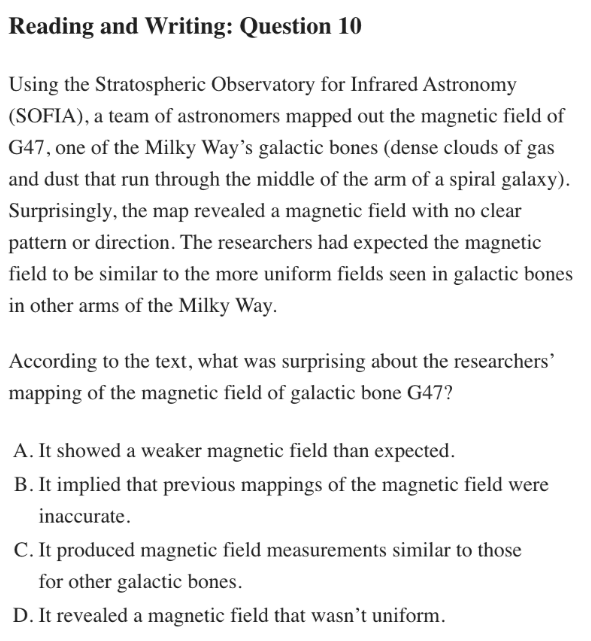
“According to the text” Question from College Board PSAT 8/9 Practice Exam

Another “According to the text” from College Board PSAT 8/9 Practice Exam
Reading Multiple Choice Questions
Interestingly, patterns are not limited to the questions themselves. Similar patterns can often be found in the answer choices.
Many SAT and PSAT Reading & Writing answers begin with recurring phrases that signal a particular function. In Function Questions, for example, students may frequently encounter answer choices beginning with phrases such as:
"To introduce..."
"To explain..."
"To emphasize..."
"To highlight..."
Over time, students begin to recognize how these recurring answer structures correspond to specific textual functions.
As a result, strong test-takers are often able to eliminate incorrect choices more efficiently and identify the most accurate answer with greater confidence. Rather than viewing every answer choice as entirely new, they learn to recognize familiar patterns that appear repeatedly throughout the exam.
The Hidden Traps of SAT Preparation
Many students prepare for the SAT by practicing many questions from variety of sources such as The Princeton Review, Mometrix, Kaplan, etc. However, there is a reason why this type of preparation may not be an effective way to study for the SAT. While resources such as Princeton Review, Kaplan, and Mometrix can provide useful practice, they are ultimately written by companies attempting to imitate College Board's testing style.
Students who spend most of their time studying non-College Board questions may become familiar with the patterns of those publishers rather than the patterns that appear on the actual SAT. For this reason, understanding how College Board designs its questions is often more valuable than simply increasing the number of practice questions completed.
A More Strategic Approach to SAT/PSAT Preparation
Understanding patterns is only the first step. The more important question is how students train themselves to recognize these patterns consistently.
Many students believe that completing a large number of practice questions will automatically lead to higher scores. While practice is certainly important, improvement often depends more on the quality of review than the quantity of questions completed.
The MetaPrep Method: A Systematic Approach to Score Improvement
At MetaPrep, we believe that meaningful score improvement comes from understanding the patterns behind the exam rather than simply memorizing rules or completing endless practice questions.
Our SAT and PSAT programs focus on pattern recognition, strategic analysis, individualized study plans, and structured skill development. Each student receives targeted instruction based on their strengths, weaknesses, and long-term goals.
About the Author
Kim is the founder and lead instructor of MetaPrep. A University of Virginia graduate with over 10 years of instruction experience, she specializes in Digital SAT and PSAT preparation, focusing on strategic problem-solving, pattern recognition, and individualized student support.
